Call
Call Text
Text
Should You Buy Fake Google Reviews?
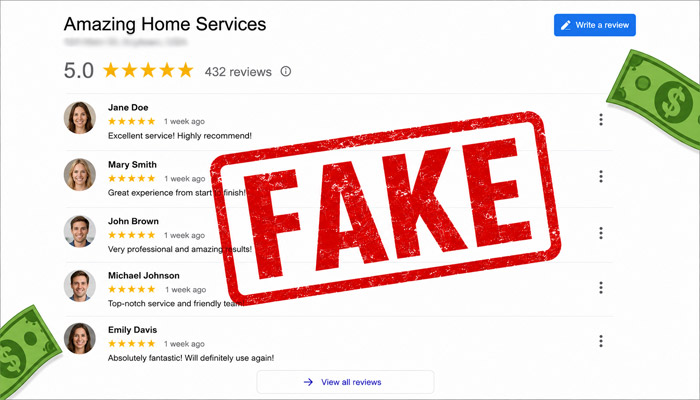
A large number of positive Google reviews can influence buying decisions quickly. Some turn to services that promise quick boosts through fake reviews. This article explains how those tactics work, the risks involved, and safer options.
Why Google Reviews Are Important
A strong collection of positive reviews on your Google Business Profile is important.
Positive Google Reviews Establish Trust
Most customers check ratings before calling or visiting a business. A high star average on a Google Business Profile, and many reviews, shows that people have had a good experience with the company. That lowers hesitation and increases the chance someone reaches out. People tend to choose the company with stronger ratings and more feedback. Even a small difference in stars can shift attention.
Positive Reviews Can Improve Your Google Business Profile Ranking and Visibility
Reviews are a major factor in the ranking of a Google Business Profile. Recent reviews show that a business is active, and companies with more positive reviews tend to appear higher in search results, which leads to more views and clicks.
Companies That Sell Fake Google Reviews
There are companies that exist that offer to post fake positive reviews on a Google Business Profile. Business owners feel pressure when competitors show hundreds of glowing reviews, so it can sound tempting if you feel stuck with low ratings or slow review growth.
These companies will rarely admit that the reviews are "fake", and they'll usually give this service a safe-sounding name. Some of the terms they may use include Reputation Management, Reputation Repair, Review Growth, Review Generation, Ratings Improvement, Local Reputation Marketing, Trust Building, Brand Credibility, etc. Real reputation management focuses on earning and responding to legitimate feedback. When the pitch centers on fast star increases with little customer involvement, there's a good chance that fake reviews are involved.
How Do Fake Review Companies Work?
Companies that provide fake reviews depend on human labor, account manipulation, and pattern control. Work is outsourced to large pools of low paid workers through private groups, freelancer sites, or messaging apps. Writers receive basic instructions. Either a script or sample text comes with it, or the workers are asked to provide their own wording.
Some providers buy old Google accounts from third-party sellers, while others employ shady companies that hack and hijack existing Google accounts. They change or add profile photos. They post a few random reviews over time. The goal is to avoid accounts that look brand new and suspicious.
Location masking plays a role. Workers use VPN tools that make their internet address appear to come from different locations. This spreads review origins across wide areas. It looks natural on the surface.
Timing control matters too. Reviews are not dropped all at once. They're spread over days or weeks. This staggered flow aims to mimic normal customer behavior.
The Benefits of Fake Google Reviews
Lots of great reviews can help your Google Business Profile rank higher, and people are more likely to call your company than your competitors' when they're searching for your products or services. So of course, the more great reviews, the better, right? Let's face it, fake review companies are popular for a reason: they work. You notice your Google Business Profile showing up higher and higher in the "map pack" (list of Google Business Profiles for 3 or 4 companies). The calls start coming in. You're getting more work. Whoo-hoo, this is the answer you've been searching for!!
But not so fast. Fake reviews are like a drug that feels great for a while, but the side effects are dreadful.
The Disadvantages of Fake Google Reviews
- It's Dishonest
I shouldn't need to state the obvious, but it's dishonest. Is that how you want to run your company? - It Violates Google's Policies
If Google finds out, they'll remove the fake reviews (actually, they'll probably remove all reviews, even those that might be legitimate), suspend the ability for anyone to leave reviews again, and most likely suspend or permanently delete your Google Business Profile. Often when the reason for the deletion of a profile is for something as egregious as fake reviews, Google will never again allow you to create a Google Business Profile for your company. You'll have to change your company name and phone number. It doesn't seem worth the increase in customers that you might get for a few months (or a few years, if you're one of the lucky ones). If you provide services or products locally, not having a Google Business Profile can really hurt your company. - Legal Risk
Fake reviews are considered deceptive advertising. The FTC has taken action against companies for misleading review practices. Fines and legal trouble are real possibilities. - Reputation Damage
Customers are getting better at spotting fake reviews. If people suspect dishonesty, trust drops fast. A damaged reputation is harder to fix than a low star rating.
How to Spot Fake Google Reviews
- Vague language
Reviews that say things like "Great service" or "Best company ever" with no details about the job are more likely to be fake (but not always). - Reviewer has hidden their other reviews
Click on the name of the reviewer. This brings up their review profile. If their reviews profile says, "This person hasn't written any reviews yet, or has chosen not to show them on their profile.", that's the "smoking gun". There's no reason someone would hide their other reviews, unless something shady was going on. - Reviews in different areas in a short period of time
If the reviewer has left reviews for companies in a lot of different geographical locations in a short time, that's a red flag. Of course, someone might be traveling, but a legitimate review for a pizza place in Arizona in the morning, a car dealership in New Jersey that afternoon, and a tree service in Maine that night, is highly suspicious. - Reviews for the same types of service performed by multiple companies
If the reviewer says they had their roof replaced by one company one day, a different roofing company the next day, and a third company the following week, something's obviously not right. - Review timing clusters
Five glowing reviews posted within two days after months of silence looks unnatural. - No mention of specific services
Real customers often mention specific work that was done, or details about the product they bought. But not always. Fake reviews tend to be more generic. - Overly perfect tone
Real reviews often include small details, balanced comments, or natural language quirks. Real reviews may also contain misspellings and incorrect grammar. Fake reviews read like ads. But as A.I. makes it a lot easier to create natural sounding reviews, this isn't always easily detectable. - Mostly foreign names
If most of the reviewers have names that appear to come from the same country or region outside the U.S., it may indicate that the fake review company hired an overseas organization to post fake reviews. The concern is the overall pattern, not a reviewer's ethnicity, nationality, or name by itself. On the other hand, too many very simple names like John Smith or Mary Brown or Ted Jones, could be a red flag as well. - A.I. Wording
This is getting harder and harder to detect, since A.I. is getting smarter. Curly apostrophes (’) instead of straight apostrophes ('), em dash (—), and en dash (–) are hallmark signs of A.I. generated text. Yes, legitimate reviewers may use A.I., but if most of the reviews have these, that's suspicious. Also, uncontracted forms of words that most people use contractions for, such as "it is" instead of "it's" or "they are" instead of "they're", are more likely to be A.I. generated.